Listening Karoonjhar - Echoes of Karoonjhar
I was completely astonished by this trip because It was ineffable in the best way possible.
6 SEPTEMBER 2026 · 2 MIN READ
So I recently got the chance to visit Karoonjhar Mountain in Nagarparkar. This five-day trip was part of the Karoonjhar Commune Art Residency by Lahooti and the British Council in Sindh, Pakistan.
I was completely astonished by this trip ... it was ineffable, in the best way possible.
With an open mind, I woke up every day to discover something completely new. One of those experiences was this dawn chorus, which I was lucky enough to capture early in the morning on 27 August 2026.
I’ll be sharing more about my experience soon.
For the recording, I used a Zoom H6 Studio with its XY capsule, recording at 96 kHz. Because I was trying to capture the quieter details of the early morning environment, the recording required relatively high gain. This also introduced some top-end self-noise, which I carefully reduced during post-production while trying to preserve the character and detail of the original recording.
I was particularly interested in treating this recording not simply as an artistic composition, but also as a sonic document of the place. The recording captures a moment in which multiple species occupy the same acoustic environment, each contributing to the changing texture of the morning. In this sense, the dawn chorus becomes a way of encountering Karoonjhar through listening—revealing aspects of the landscape that may not be immediately visible.
With the help of BirdNET analysis, I was able to identify several bird species within the recording:
Laughing Dove Streptopelia senegalensis 73.6% confidence — 374 detections
Red-vented Bulbul Pycnonotus cafer 38.7% confidence — 139 detections
Indian Peafowl Pavo cristatus 14.3% confidence — 14 detections
Common Tailorbird Orthotomus sutorius 11.3% confidence — 28 detections
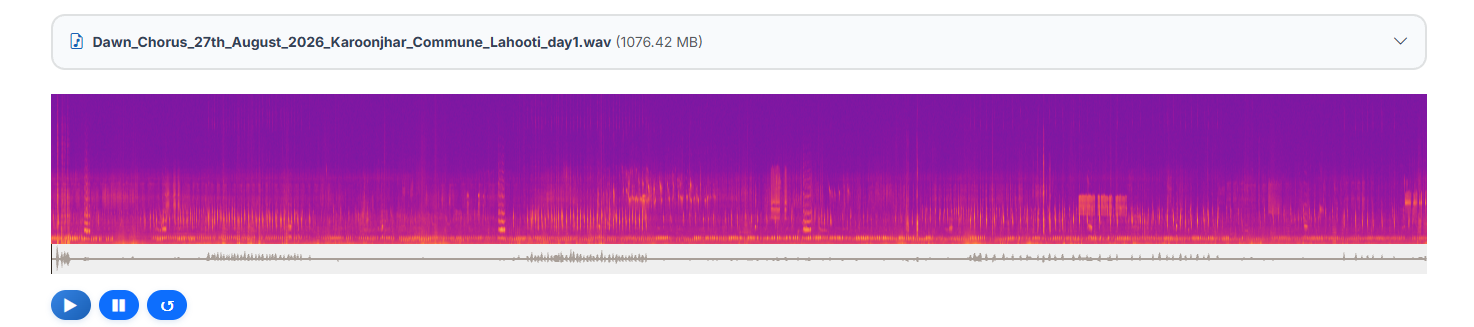
What interests me here is the possibility of approaching a field recording as both evidence and experience. The recording can tell us something about the acoustic ecology of Karoonjhar, while simultaneously allowing us to experience the landscape through its sounds.
This is only one small fragment of what I encountered during those five days. I hope to share more from the residency soon.
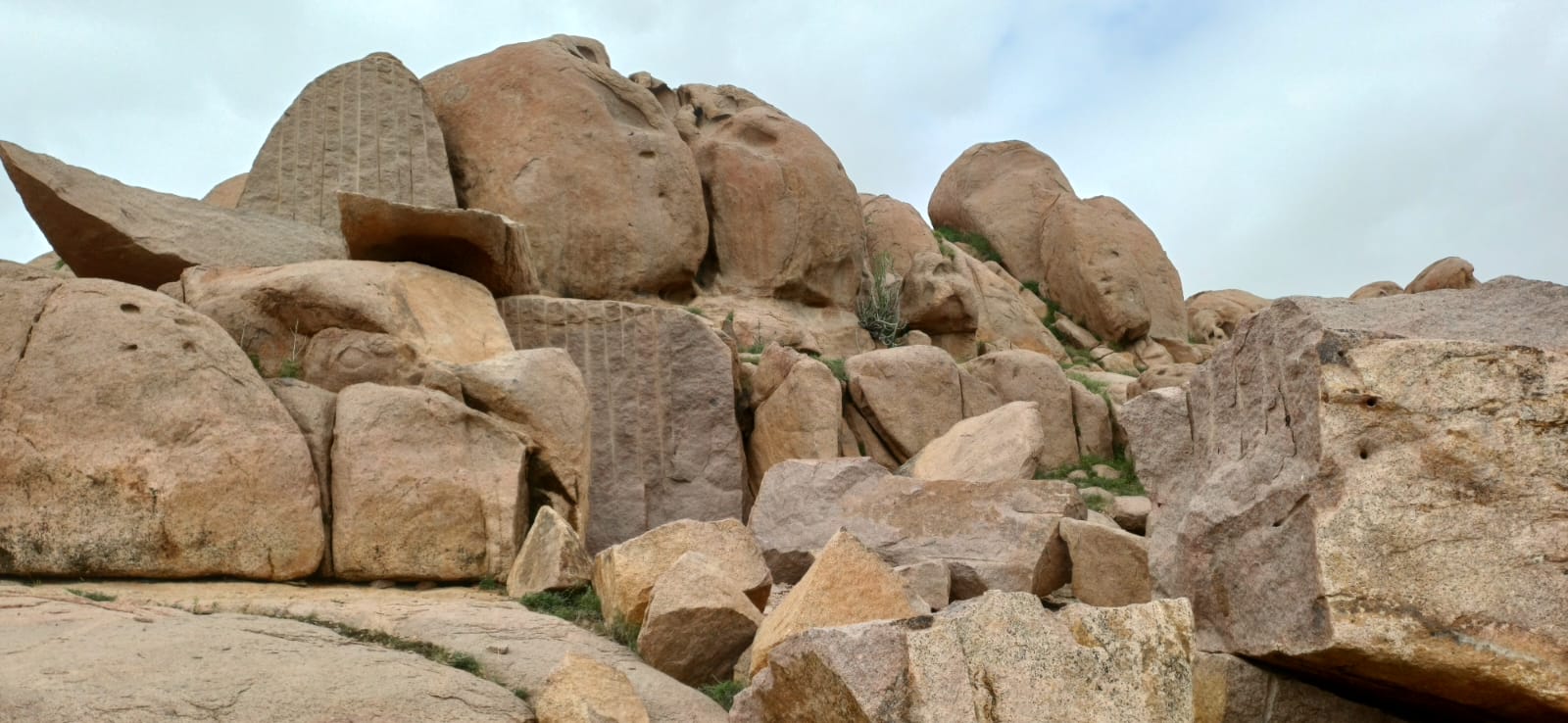
This image shows a section of Karoonjhar Mountain where rocks were previously cut and extracted for mining. Mining activities have since stopped, thanks to the efforts of Saif Samejo.